BACK
The Golden Ratio in Art-
|
|
|


Artists have long sought a key to ideal proportions. The Greeks often used the "golden ratio" - which states that:
"The small is to the large, as the large is to the whole."
The Parthenon facade is said to be (though this is disputed) a "golden rectangle" in which the small side relates to the large, as the large relates to the sum of the small and large added together.
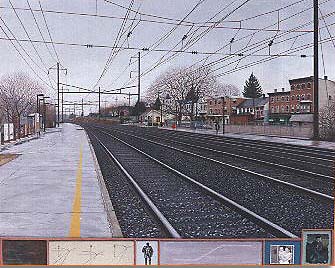
Some Dutch landscape painters would use a golden "section" to place the horizon line on the canvas as shown in the above graphic.
An easy to use example is 3 to 5 (or 3.05 to 4.95)
In this case- 3.05 is 61% of 4.95 and 4.95 is 61% of 8
So a canvas 30 x 49 is almost a perfect "golden rectangle." Many things in nature exhibit a golden ratio- maple trees; wolves and other animals- if placed in a rectangle- fill a "golden" rectangle.
What is the value of this to artists today? It at least makes us wary of dividing things in half, creating "fracture points" right where a design is most likely to break. Fred Danziger